

Chief Editor
Last updated: December 21, 2025
If you care about getting your money fast, the casino matters. However, the withdrawal method often matters more. Two players can cash out from the same site on the same day and end up with completely different wait times because one chose a bank-linked method and the other used crypto.
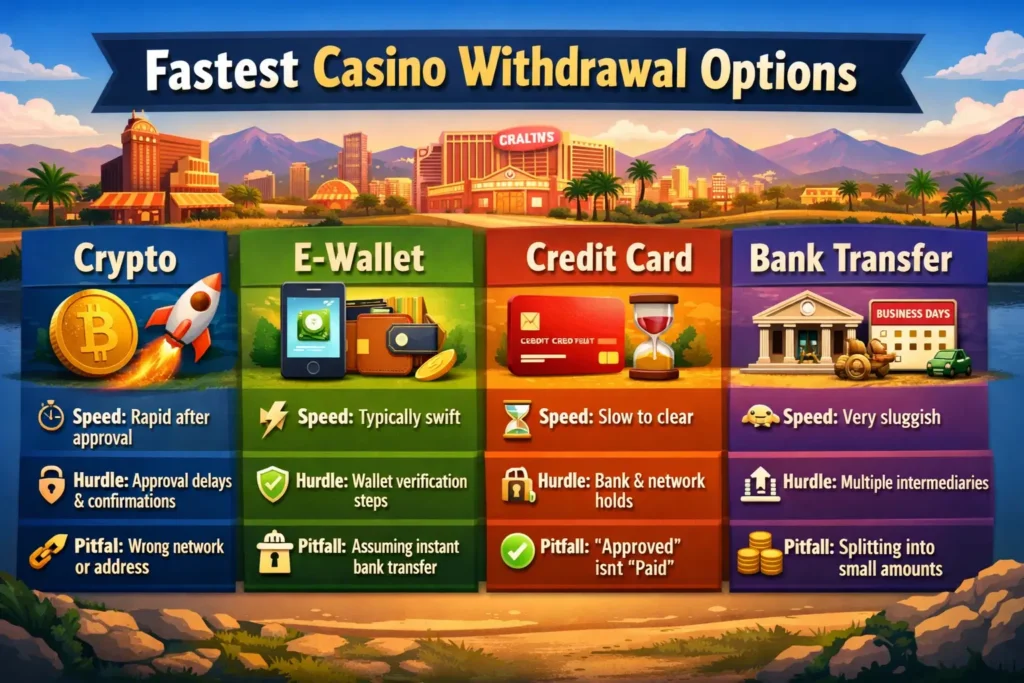
Where withdrawals get slow
Every withdrawal has two separate clocks: casino processing (review + approval) and delivery (the method moving money to you). Most players only think about the first one. The second adds days which is not good.
If you want a clear breakdown of the full pipeline from request → review → paid, read how casino payouts work. For realistic payment options see casino withdrawal times.
What “fastest” means in real life (not marketing)
“Instant withdrawals” mean instant approval or a fast internal queue, not zero-time settlement. Even crypto needs internal release plus network confirmations. Cards and banks add additional layers and hold times. The fastest method is the one with the fewest third parties and the least reversibility.
Also: the first cashout is commonly slower than later ones due to verification and payment-method checks. If the casino delays your withdrawal request for “review” or “verification”, don’t panic, it doesn’t mean that it’s “being slow.”
Crypto withdrawals (Bitcoin, USDT, and why they’re usually fastest)
For USA-facing casinos, crypto is the fastest withdrawal route because it bypasses banks and card networks. Once a casino approves the payout, funds move directly to your wallet. That removes a lot of “batching” and “business-day” delay that comes with traditional rails.
Reality check: crypto speed depends on two things: (1) How quickly the casino releases the transaction, and (2) how fast the network confirms it. The network part is public; you can see it via a blockchain explorer.
Bitcoin vs stablecoins
Bitcoin is widely popular and reliable, but it can slow down during network congestion. Stablecoins (like USDT) can be quicker on certain networks.
But they introduce a common failure point: sending to the wrong chain or using incompatible addresses. That error doesn’t “delay” the payout it can cause permanent loss. Fast is useless if you send your coins to the wrong address.
Where crypto delays usually happen
- Internal approval queue: the casino hasn’t released the transaction yet.
- Security holds: large withdrawals or unusual activity trigger manual release.
- Network confirmations: the transaction exists but needs confirmations.
- Wallet handling: if you use an exchange deposit address, exchanges may hold funds before crediting.
Crypto is the method most associated with “same day” payouts, but it still isn’t magic. If your withdrawal slows down, the first question is always: Is the casino still processing it, or is it on-chain?
Card withdrawals (debit/credit): familiar, but rarely fast
The problem is cards require extra compliance with possible reversal windows. Even after a casino approves a card withdrawal, your bank and the network can delay a withdrawal you can’t control.
Why cards slow down
- Batch processing: some settlements aren’t “real-time” and post in cycles.
- Issuer review: the bank may flag unusual credits or cross-border patterns.
- Chargeback risk: reversibility increases scrutiny and hold behavior.
If you prefer speed, cards are not the best choice. If you like convenience and accept slower settlement, cards are fine. However, don’t confuse “casino approved” with “money in your account.”
Bank transfers and wires: dependable, but slow by design
For many players, bank transfer delays feel like the casino is stalling, but a lot of the waiting happens after the casino done its part.
If you’re withdrawing to a bank, you should assume extra time for additional verification if the amount is large or the pattern looks unusual. That’s especially true for cross-border wires.
| Bank Method | What slows it down | Best use case |
|---|---|---|
| ACH / local transfer | batch settlement + verification triggers | routine withdrawals where speed isn’t critical |
| Wire transfer | intermediaries + business-day handling | larger cashouts where reliability matters |
E-wallets and prepaid methods: fast when available, limited in the USA
E-wallets can be fast because they sit between the casino and your bank. If the casino pays to the wallet quickly, you’ve effectively completed the casino side of the process. The remaining step is wallet → bank (if you cash out that way).
For many USA-facing casinos, e-wallet availability is inconsistent. Where it exists, the real advantage is predictability: wallet credits often post sooner than bank settlement.
The catch is verification: wallets may require their own identity checks, and that can feel like “another delay” even when the casino pays fast.
Speed vs safety vs convenience (the honest comparison)
The best method depends on what you’re optimizing for.
| Method | Typical speed profile | Main friction | Common mistake |
|---|---|---|---|
| Crypto | fast once approved | approval queue + confirmations | wrong network/address |
| E-wallet | often quick to wallet | wallet verification | assuming wallet→bank is instant |
| Card | slow settlement | bank/network holds | thinking “approved” = paid |
| Bank | slowest, most rigid | business days + intermediaries | multiple small transfers |
How to get faster payment (without begging support)
Method choice is only half the equation. The other half is avoiding triggers that slow approvals. To speed up withdrawals experienced players focus on the following:
- Verify early: if you wait until you win, you’re the “risk case” the casino has to process.
- Keep the method consistent: switching methods midstream often triggers extra checks.
- Avoid bonus entanglement: bonuses can lock balances, cap cashouts, and stall withdrawals.
- Request one clean withdrawal: multiple small cashouts can slow the queue and raise review flags.
- Don’t change details while pending: edits, resubmits, and “new requests” restart review.
If you want a deeper breakdown of what triggers delays (KYC, review holds, bonus locks), see: why casino withdrawals delay for USA players.
Why “compliance” keeps showing up for U.S. players
Offshore casinos serving U.S. players still face pressure from processors and financial monitoring standards. That’s why large withdrawals trigger checks that don’t appear during gameplay.
You don’t need to love it, but you do need to understand it. AML monitoring is the reason casinos verify identity at cashout. FinCEN’s AML overview is a useful baseline reference here: U.S. FinCEN anti-money-laundering overview.
The takeaway: If a casino asks for documents, it’s often because the payout method and the risk controls intersect at withdrawal, not because they suddenly “decided to be difficult.”
Choosing the right withdrawal method based on your situation
If your goal is fast access, crypto is the practical winner. The condition though you must be comfortable using wallets correctly. If your goal is simplicity, cards and banks may feel easier but brace yourself for delays and additional checks.
Pick crypto if: speed matters, you can handle wallet basics, and you want fewer third-party delays.
Choose e-wallets if: they’re available, and you want a fast intermediate step before moving funds again.
Pick cards if: familiarity matters more than speed; you accept bank delays.
Pick bank transfers if: reliability and audit trail matter, and you’re okay with business-day timing.
If you’re building your strategy around speed, choose casinos that consistently approve withdrawals quickly. For the main list of fast-paying options, see our fast payout casinos guide.