

Chief Editor
Last updated: December 21, 2025
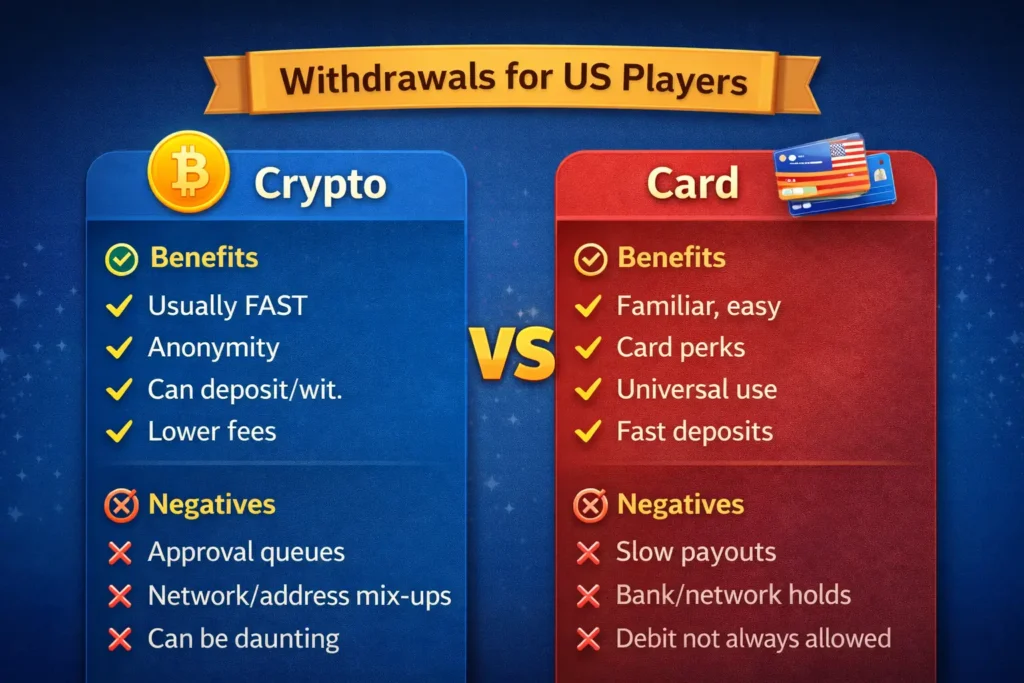
When U.S. players choose a withdrawal method, the decision usually comes down to two options: cryptocurrency or debit/credit cards. While both can work, they behave very differently once a withdrawal is requested.
This page explains how crypto and card withdrawals compare in practice — not in marketing claims. Speed, reliability, verification friction, and failure risk all matter more than headline promises.
Why withdrawal method choice matters
Many payout delays blamed on casinos are actually caused by the payment method chosen. The same casino can pay one player within hours and another in days depending on how funds are withdrawn.
This is because different methods introduce different intermediaries:
- cards rely on banks, issuers, and payment networks
- crypto relies on wallets and blockchains
Each layer adds friction, review points, and failure modes. This is why method choice plays a central role in payout speed, as explained on fastest casino withdrawal methods .
How card withdrawals actually work
Card withdrawals feel familiar, but they are rarely fast. Even after a casino approves a payout, funds must pass through issuing banks and card networks before reaching the player.
Typical card withdrawal stages include:
- casino approval and batching
- processor submission
- issuer review
- bank settlement
Each stage introduces delays that the casino cannot control. Weekends, holidays, and bank processing windows further slow the process.
Cards are also reversible, which increases chargeback risk. As a result, casinos tend to apply stricter verification and limits to card withdrawals.

How crypto withdrawals actually work
Cryptocurrency withdrawals remove banks and card networks from the equation. Once approved, funds are sent directly from the casino to a player-controlled wallet.
Crypto withdrawals typically involve:
- internal casino approval
- transaction broadcast to the blockchain
- network confirmations
After broadcast, the casino no longer controls the transaction. Confirmation speed depends on network conditions and fees, not banking hours.
Because crypto transactions are irreversible, casinos face less chargeback exposure. This often results in faster approval once internal checks are complete.
Speed comparison: crypto vs cards
| Factor | Crypto | Cards |
|---|---|---|
| Typical payout time | same day to 24 hours | 3–7 business days |
| Weekend processing | yes | rare |
| Bank involvement | none | required |
Speed differences alone explain why crypto is often recommended to players who prioritize fast access to winnings.
Verification and friction differences
Both methods can trigger verification, but the intensity differs.
Card withdrawals usually involve:
- ownership checks for the card
- issuer-level reviews
- higher chargeback scrutiny
Crypto withdrawals typically focus on:
- identity verification
- wallet compatibility
- AML screening
While neither method avoids verification entirely, crypto tends to involve fewer external parties once approved.
Why players still choose cards despite slower payouts
Despite slower processing, many players continue to use cards because they are familiar and feel safer. Cards offer reversibility, dispute options, and integration with existing bank accounts.
However, these same protections are what slow payouts and increase friction at the withdrawal stage.
Understanding this trade-off helps players choose a method aligned with their priorities rather than defaulting to habit.
Failure modes: how withdrawals actually break
Both crypto and card withdrawals fail for different reasons. Understanding these failure modes explains why some payouts bounce, stall, or require resubmission.
| Method | Common Failure Cause | What Happens |
|---|---|---|
| Crypto | invalid or incompatible wallet address | withdrawal rejected before broadcast |
| Crypto | network congestion | confirmation delay, not casino delay |
| Cards | issuer rejection | funds reversed or never credited |
| Cards | bank compliance review | multi-day delay |
Crypto failures usually happen before funds leave the casino. Card failures often happen after the casino has already processed the withdrawal.
Fees and hidden costs
Fees are handled very differently depending on the withdrawal method.
With crypto, fees are explicit. A transaction fee is paid to the network and affects confirmation speed. With cards, fees are indirect and often invisible to the player.
| Cost Type | Crypto | Cards |
|---|---|---|
| Network / processing | explicit blockchain fee | embedded in bank processing |
| Currency conversion | depends on exchange used | often automatic and opaque |
Neither method is free. Crypto trades transparency for volatility, while cards trade familiarity for slower, less predictable settlement.
Reversibility vs finality
One of the biggest differences between crypto and card withdrawals is reversibility.
Card payments can be disputed or reversed. This gives players consumer protection, but also creates chargeback risk for casinos.
Crypto transactions are final once confirmed. There is no dispute mechanism. This is why casinos are more cautious before sending crypto — but faster afterward.
Trade-off: cards offer protection but slow payouts; crypto offers speed but requires accuracy and self-custody responsibility.
Verification intensity by method
Verification applies to both methods, but it escalates differently.
Card withdrawals often trigger:
- proof of card ownership
- bank-side reviews
- issuer compliance checks