
Casino verification or KYC (Know Your Customer) is the #1 reason a “fast” withdrawal turns into a long wait. Most players don’t hit verification when they deposit or play; they hit it when they try to cash out. That timing makes it feel suspicious, low friction on the way in, higher checks on the way out.
This guide explains what KYC is. What triggers it for USA-facing casinos, what documents they need, how to submit them correctly the first time, and how to tell a normal compliance check from a payout-stalling tactic.
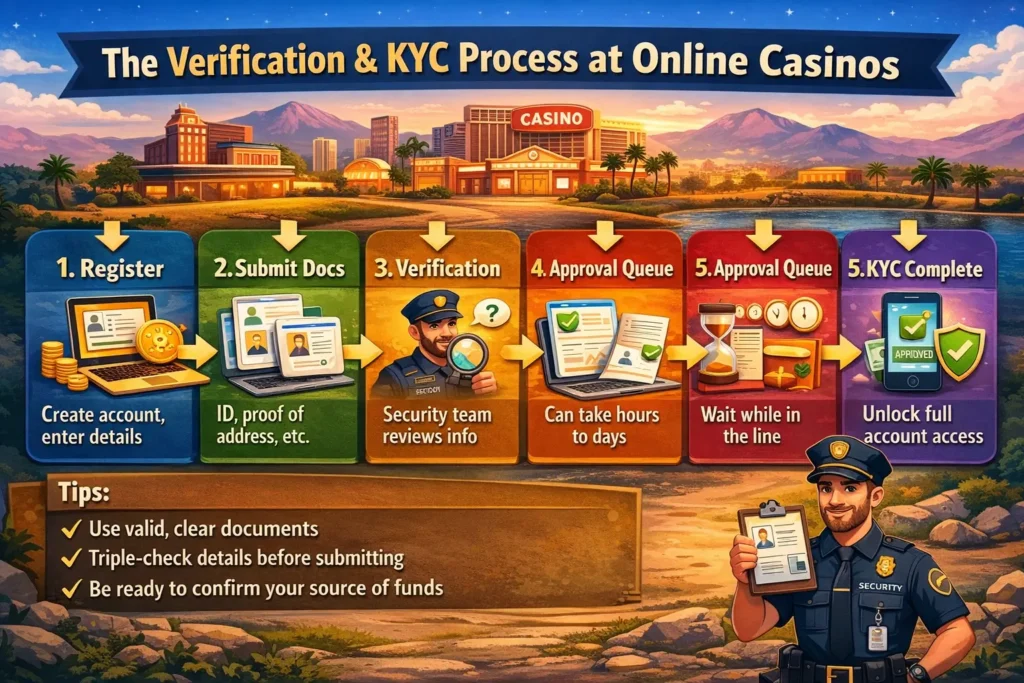
What KYC means (and what it is not)
KYC is a bundle of identity and payment checks used to confirm three basic things:
(1) You are a real person
(2) It’s your account
(3) The withdrawal destination belongs to you.
Casinos use KYC to reduce fraud, account takeovers, chargebacks, and bonus abuse. None of that is “fun,” but it’s standard in online gambling and payments.
What KYC is not: It is not a guarantee the casino is slow paying; it is not automatically a scam signal; and it is not the same thing as “the casino doesn’t want to pay.” KYC becomes a problem when it’s repeated, inconsistent, or open-ended. More on that below.
Why verification is often triggered at withdrawal
Many casinos defer verification because it improves conversions. If every player had to upload documents before playing, signups drop. Instead, casinos allow fast onboarding and move the friction to the moment money leaves the system. From the operator’s point of view, that’s when the financial and legal risk appears.
At cashout, a casino needs to be comfortable with two risks at once: identity risk (is this account legitimate?) and payment risk (is the withdrawal method clean and owned by the same person?).
That’s why first withdrawals frequently take longer than repeat withdrawals. Once you establish a verified payout profile, subsequent cashouts can move faster.
If you want the broader picture of delays beyond KYC such as pending periods, bonus locks, processor issues, visit see why casino withdrawals get delayed (USA players).
Common triggers that flag an account for KYC
Casinos don’t “randomly” choose verification. Triggers vary by site, but the patterns are consistent:
- First withdrawal: the standard trigger. Expect it.
- Large withdrawals: anything above internal thresholds can force manual review.
- Deposit/withdraw pattern changes: new cards, new wallets, new banks, or sudden method switches.
- Bonus completion: wagering met, now the casino checks for bonus abuse or restricted play.
- Velocity and behavior: many deposits in a short window, very fast bet cycling, or unusual play patterns.
- Geo/device mismatch: frequent IP/device changes can look like account sharing.
Most of these triggers are automated. The withdrawal request hits the system, a rule fires, and your cashout goes into a verification queue. That’s why it can feel instant: “I requested a withdrawal and suddenly they want my ID.”
Important: if your account is flagged, creating more activity often makes it worse. Submitting new withdrawals, switching methods, or changing profile details can restart reviews and extend waiting time.
What casinos usually ask for
For USA-facing casinos, the document set is usually straightforward. Delays come from poor submissions, mismatches, or missing pages, not from the concept of verification.
| Document | What they’re checking | Common rejection reason |
|---|---|---|
| Government photo ID | Name, age, photo match, expiration | Expired, blurry, cropped corners, glare |
| Proof of address | Name + address match, recency | Too old, address doesn’t match profile, incomplete page |
| Payment method proof | Ownership of deposit/withdraw method | Wrong method shown, missing name, unclear screenshot |
The most common verification delays are caused by blurred photos, cropped documents, expired IDs, or mismatched names and addresses. Most of this is avoidable.
How to submit KYC correctly (so it doesn’t bounce back)
If you want fast payouts, the goal is not “hope they don’t verify you.” The goal is “if they verify me, I pass first time.” Here’s what prevents the back-and-forth:
Fast-pass checklist
- Upload clear, uncropped images with all four corners visible.
- Make sure your account name matches your documents (same spelling, same order).
- Use proof of address showing date + name + full address on one page.
- Send ID + address + payment proof together when possible (one complete submission).
- Avoid editing images. Cropping/markup/filters can trigger “tampered document” flags.
- If asked for front/back, submit both sides in the same ticket/message.
Small mistakes waste the most time. A photo might look “fine” to you, but if compliance can’t read numbers instantly, it gets rejected. Rejections are not just annoying they often place you back into a queue.
Payment-method verification: the part players miss
Identity verification is only half the story. Casinos also validate the payment method used to deposit and withdraw. This is where players accidentally create delays by switching methods midstream.
Common triggers for extra checks:
- Depositing via one method, withdrawing via another without a clean audit trail.
- Using a card that doesn’t display your name (some prepaid cards), then failing ownership proof.
- Providing a new withdrawal destination every time (new bank account, new wallet, new exchange).
Even when casinos allow method switching, it often forces manual review. If speed is your goal, keep the method consistent until your account has a clean payout history. For method-level guidance (crypto vs cards vs banks), see fastest casino withdrawal methods.
How long KYC typically takes (and why “pending” isn’t a useful word)
Players get stuck on the word “pending.” Pending just means “not finished.” A withdrawal becomes “pending” for different reasons: waiting for documents, waiting for review, waiting for a manager approval, waiting for processor response, or waiting for you to correct something. KYC-related pending is usually one of two states:
- Awaiting documents: the casino is waiting on you. Nothing moves until you submit.
- Under review: documents are submitted and being checked. This is the queue stage.
What matters is whether the casino can tell you which stage you’re in. A legitimate operator usually provides a clear status: “documents received,” “in review,” “approved,” or “needs resubmission.” Vague replies like “please wait” with no status are where delays become concerning.
Bonus-related KYC: why verification can show up right after wagering
Bonuses change the risk profile. When you finish wagering, the casino often verifies that play complied with terms: restricted games, max-bet rules, multiple accounts, or prohibited patterns. This is why verification sometimes appears right when you think you’re “done.”
If you’re playing for speed, the simplest approach is to avoid bonuses on sessions where you intend to withdraw quickly. If you do take a bonus, assume you may face extra review at cashout and keep your documents ready.
Repeated verification requests: normal vs problematic
One verification request is normal. Two can be normal if you submitted something unclear. Repeated requests that keep changing are where you should pay attention. Here’s the clean separation:
| Normal verification | Concerning verification |
|---|---|
| Clear list of required documents | Requirements change each time you comply |
| Specific rejection reason (blurry, expired, mismatch) | Vague rejections with no detail |
| Status updates (received → in review → approved) | Indefinite “under review” with no timeline |
| One-time process, then faster future payouts | KYC repeated for every withdrawal without explanation |
Practical rules to avoid triggering extra checks
- Verify before you need the money: do it early, not after a big win.
- Don’t change profile details during a pending withdrawal: edits can restart review.
- Avoid multiple small withdrawals: consolidate; it reduces queue friction.
- Keep devices and logins consistent: constant switching can look like account sharing.
- Stay consistent with payment methods: method hopping triggers compliance.
These rules are boring, but they work. Most “KYC nightmares” are self-inflicted by method switching, partial submissions, or changing details mid-process.
What to do if your verification is stuck
If KYC takes longer than you anticipated, the goal is to create clarity without resetting the queue:
- Ask support for the exact missing item or the exact rejection reason.
- Confirm whether the withdrawal is waiting on documents or review.
- Submit a complete set in one message, then wait—rapid resubmits can restart review.
- Do not open new withdrawal requests while KYC is unresolved.
If they cannot state what they need or cannot confirm a review stage, treat that as a risk signal and stop adding complexity to the account.
Bottom line: KYC is normal, but sloppy submissions and method switching make it slow. Handle verification early, keep your withdrawal method stable, and most payout delays disappear after the first successful cashout.